Machine Learning Potentials
Allegro MLPES Workflow for MAPbI3
This note records a practical workflow for training an Allegro machine-learning potential from VASP molecular-dynamics data. The example is a 48-atom H/Pb/C/I/N perovskite cell, but the checks are meant to be reusable: make the DFT labels consistent, sample configurations from the target thermodynamic region, train with a conservative Allegro configuration, and validate the potential with both test-set errors and short MD diagnostics.
Background
Allegro is an E(3)-equivariant interatomic potential implemented as an extension of the NequIP framework. The model learns local, symmetry-respecting atomic representations and maps them to energies and forces. Its locality makes it attractive for larger molecular-dynamics simulations, especially when deployed through the pair_allegro LAMMPS interface.
The main lesson from this workflow is not a new hyperparameter trick. Most unstable potentials I encountered were caused by ordinary engineering mismatches: DFT labels generated with inconsistent settings, sampling trajectories that did not represent the intended temperature window, unit mismatches in optional short-range terms, and deploying a final checkpoint instead of the best validation checkpoint.
Principle
A machine-learning potential only learns the distribution it sees. For a finite-temperature MD potential, the useful dataset should therefore combine consistent DFT labels with configurations drawn from the temperature and structural region in which the model will be used. Before training, I check four quantities in the assembled extxyz file: number of frames, species counts, finite energies and forces, and the minimum pair distance distribution.
I also keep the first training pass simple. Optional pair potentials such as ZBL are useful for high-energy close-contact events, but they introduce another unit and mapping surface. For the first stable model, I train Allegro without ZBL, validate the learned potential, and only then decide whether an explicit short-range term is needed.
Installation
Allegro is distributed on PyPI as nequip-allegro. It depends on NequIP, PyTorch, e3nn, and Lightning. On a cluster, I prefer an explicit conda environment and fixed versions, then call the console scripts by absolute path inside Slurm jobs.
conda create -n allegro python=3.10
conda activate allegro

# Install a PyTorch build appropriate for the local CUDA driver first.
pip install torch

# Allegro is published as nequip-allegro on PyPI.
pip install nequip-allegro

nequip-train --help
nequip-compile --help
nequip-package --help
The environment used here contained PyTorch 2.7.1, e3nn 0.5.6, NequIP 0.11.1, and Allegro 0.6.3.
LAMMPS Interface
Allegro models are used in LAMMPS through the pair_nequip_allegro plugin. For Allegro specifically, the LAMMPS pair style is allegro. The model must first be compiled from a checkpoint or packaged model.
# TorchScript model for LAMMPS or other inference targets.
nequip-compile \
  best_epoch_0999.ckpt \
  formal_nve970_lammps.nequip.pth \
  --device cuda \
  --mode torchscript

# AOTInductor export for the Allegro LAMMPS pair style.
nequip-compile \
  best_epoch_0999.ckpt \
  formal_nve970_lammps.nequip.pt2 \
  --device cuda \
  --mode aotinductor \
  --target pair_allegro
A minimal LAMMPS fragment is:
units metal
atom_style atomic
read_data mapbi3.data

pair_style allegro
pair_coeff * * formal_nve970_lammps.nequip.pth H Pb C I N

timestep 0.00025
thermo 100
run 10000
The order after pair_coeff * * maps LAMMPS atom types to model type names. This mapping, together with the LAMMPS unit system, should be checked before interpreting any MD instability as a model failure.
Workflow
The dataset used here follows an NVT -> NVE -> stride sampling protocol.
- Run an equilibrated finite-temperature NVT trajectory with the same DFT settings intended for labeling.
- Select representative NVT snapshots as starting structures for several short NVE branches.
- Run each NVE branch with consistent VASP settings and a conservative timestep.
- Discard the initial transient part of each branch and sample every fixed number of frames.
- Collect all sampled frames into one ASE-readable
extxyzfile and audit it before training.
For this run, five NVE branches were started from late NVT snapshots. Each branch used 3000 MD steps; the first 100 steps were discarded, and every 15th frame was collected. The final training dataset contained 970 frames with 48 atoms per frame.
python3 prepare_nve_branches.py

python3 collect_nve_samples.py \
  --job-root nve5_encut600_330K_20260526 \
  --output nve5_encut600_stride15_discard100.extxyz \
  --discard 100 \
  --stride 15
The corresponding published helper scripts are:
Training Configuration
The model was trained with a single GPU. The split was 80/10/10 for train/validation/test. The cutoff radius was 6 Angstrom, the scalar feature width was 128, and the model used two Allegro layers. ZBL was disabled for this first stable potential.
The full configuration is available as formal_nve970.yaml. The essential parts are:
run: [train, test]

cutoff_radius: 6.0
chemical_symbols: [H, Pb, C, I, N]
model_type_names: ${chemical_symbols}

data:
  _target_: nequip.data.datamodule.ASEDataModule
  split_dataset:
    file_path: <DATA_ROOT>/nve5_encut600_stride15_discard100.extxyz
    train: 0.8
    val: 0.1
    test: 0.1
  transforms:
    - _target_: nequip.data.transforms.NeighborListTransform
      r_max: ${cutoff_radius}
    - _target_: nequip.data.transforms.ChemicalSpeciesToAtomTypeMapper
      chemical_symbols: ${chemical_symbols}

trainer:
  _target_: lightning.Trainer
  max_epochs: 1000
  devices: 1
  num_nodes: 1
  callbacks:
    - _target_: lightning.pytorch.callbacks.ModelCheckpoint
      monitor: val0_epoch/weighted_sum
      mode: min
      save_top_k: 5
      save_last: true
      auto_insert_metric_name: false
      filename: best_epoch_{epoch:04d}

num_scalar_features: 128

training_module:
  _target_: nequip.train.EMALightningModule
  loss:
    _target_: nequip.train.EnergyForceLoss
    per_atom_energy: true
    coeffs:
      total_energy: 1.0
      forces: 1.0
  optimizer:
    _target_: torch.optim.Adam
    lr: 0.0005
  model:
    _target_: allegro.model.AllegroModel
    compile_mode: compile
    model_dtype: float32
    r_max: ${cutoff_radius}
    l_max: 2
    num_layers: 2
    num_scalar_features: ${num_scalar_features}
    num_tensor_features: 64
The Slurm driver that trains, packages, compiles, and launches the first MD smoke test is linked here: run_train_then_md.slurm.
Packaging and ASE Validation
After training, I use the best validation checkpoint rather than the final checkpoint by habit. The selected checkpoint was best_epoch_0999.ckpt.
nequip-package build \
  best_epoch_0999.ckpt \
  formal_nve970.nequip.zip

nequip-compile \
  best_epoch_0999.ckpt \
  formal_nve970_ase_cuda.nequip.pth \
  --device cuda \
  --mode torchscript \
  --target ase \
  --data-path nve5_encut600_stride15_discard100.extxyz \
  --num-frames static \
  --num-nodes static
The ASE calculator is loaded through NequIPCalculator.from_compiled_model. The scripts used for the NVT and NVE diagnostics are linked here:
Result
The formal training job completed normally after 1000 epochs. The test-set metrics were:
forces_mae = 0.0188637 eV/Angstromper_atom_energy_mae = 0.000543379 eV/atomtotal_energy_mae = 0.0260822 eVweighted_sum = 0.00970355
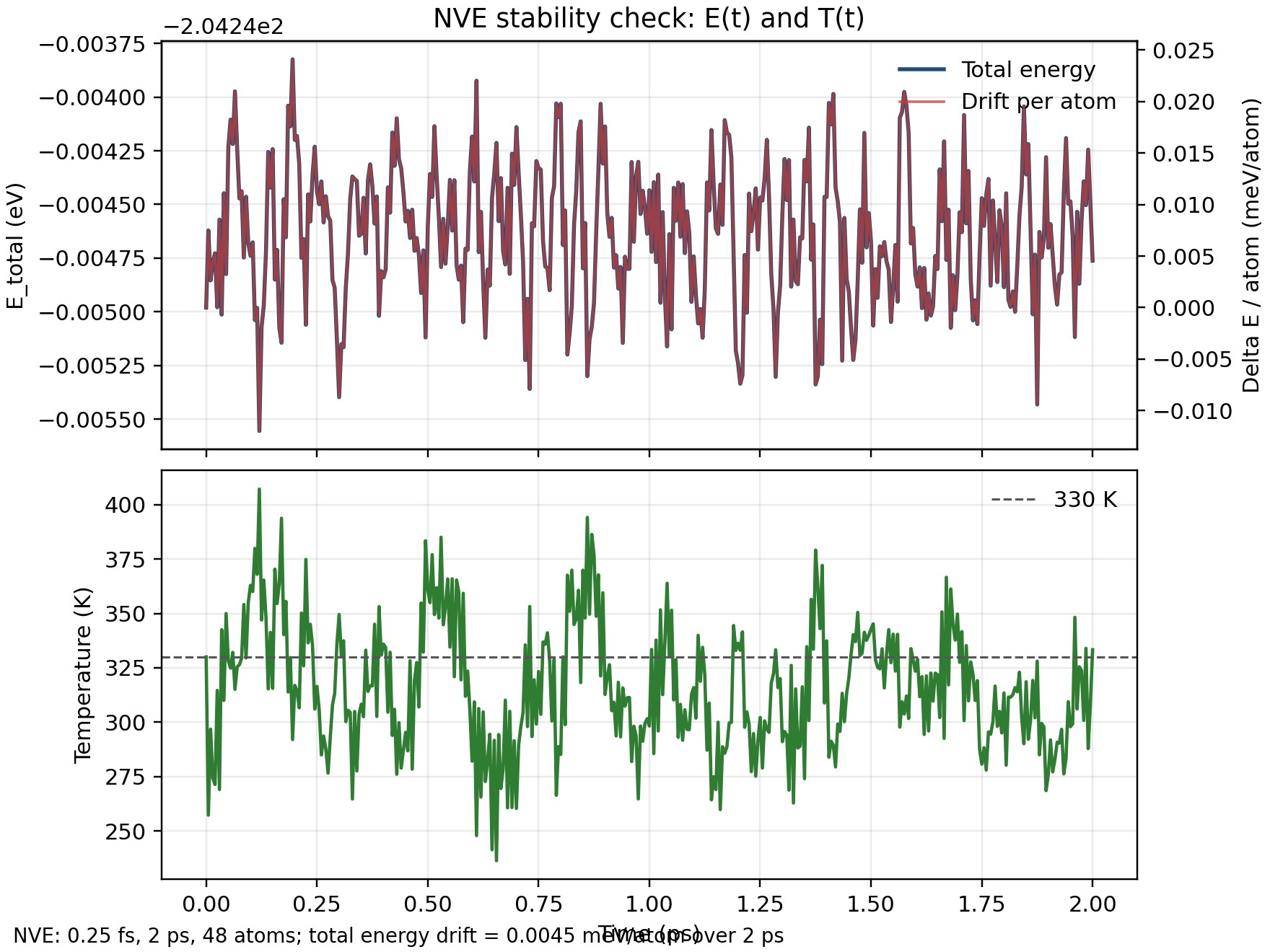
I then ran short dynamics tests. Weakly coupled Langevin NVT runs were stable but hotter than the 330 K target, so I did not treat them as production MD. A conservative NVE check was more diagnostic: 0.25 fs timestep, 2 ps total time, 48 atoms, and initial temperature 330 K.
Practical Lessons
- Check the actual DFT output used for labels, not only the input templates. The training set should not mix label levels unless this is intentional and documented.
- Sample from the intended thermodynamic region. Structures from a nominal trajectory are not enough if velocities, temperatures, or equilibration windows are inconsistent.
- Audit the final
extxyzfile before training: frame count, species count, finite energies and forces, cell/PBC fields, stress fields, and close contacts. - Start with a no-ZBL model unless the dataset and deployment units have been checked carefully. If ZBL is added later for VASP/LAMMPS metal units, the unit setting should be consistent with eV and Angstrom.
- Deploy the best validation checkpoint, not automatically the last checkpoint.
- Use NVE energy conservation as an early MD diagnostic. Thermostat behavior can obscure whether the learned PES itself is stable.
- For LAMMPS, check both the
pair_coeffatom-type mapping and the unit system before debugging the neural network.